
Hypermobility in yoga: When too much flexibility becomes a challenge.


When people talk about yoga, they often say, "I'm too stiff, I can't do yoga." Stiffness is presented as a problem, when in reality, it isn't. Being stiff isn't a big deal: it can be worked on, it improves with practice, patience, and body awareness.
What is talked about much less is hypermobility.
And yet, it is a reality for many practitioners, and sometimes a real challenge to manage on the mat.
What is hypermobility?
Hypermobility is the condition of having particularly flexible joints, sometimes "too" flexible. It can simply stem from our genes or be due to prolonged physical activity. The ligaments, which should stabilize the joint, allow more play than normal. This results in a greater range of motion, which may seem advantageous in certain yoga poses… but can also weaken the body in the long run.
Quick reminder: What is the difference between hyperlaxity and hypermobility?
In the example of the cat and cow pose in yoga, if the elbows move forward, it is primarily due to hyperlaxity: the ligaments around the elbow joint are looser, so the joint is not naturally held in its axis.
This leads to hypermobility of the elbow: the movement goes beyond its normal range, and the wrist-elbow-shoulder alignment is lost.
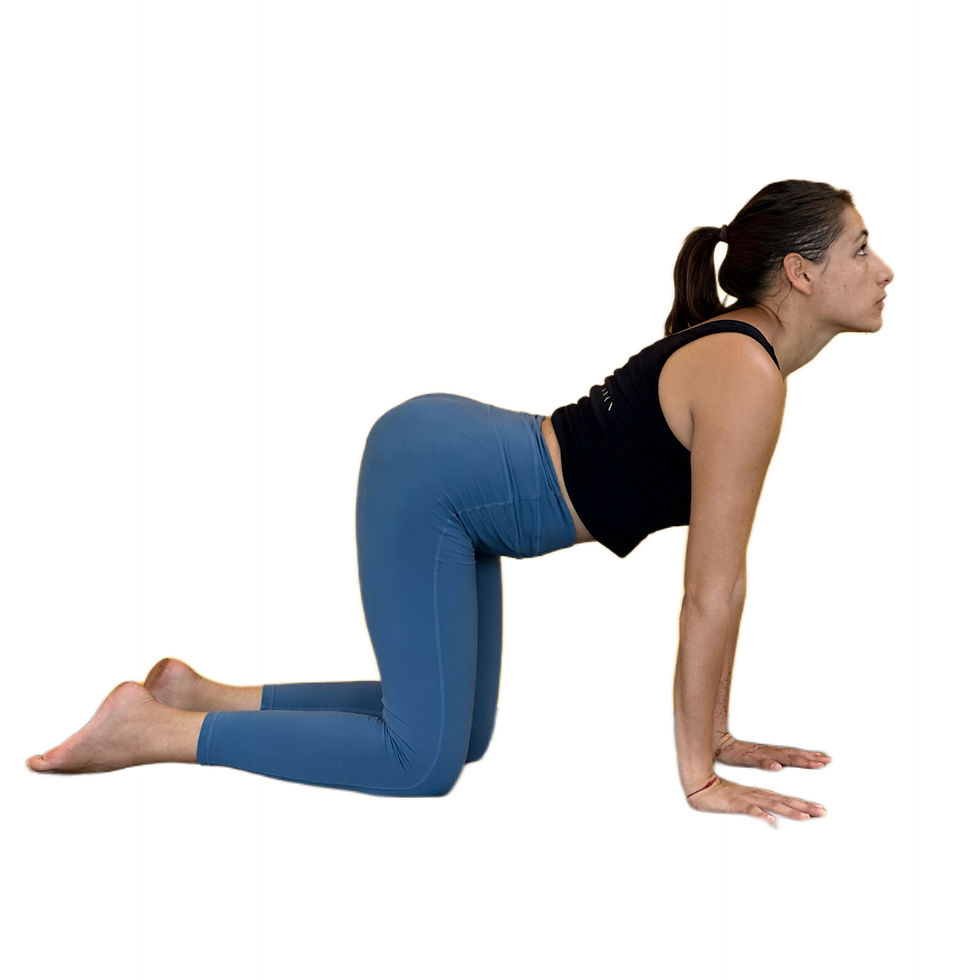

In the cat-and-cow pose, as seen above,
It is often observed in hypermobile individuals that the elbows move forward. This means that the elbow joint is somewhat loose.
At the time, there may not be any pain, but in the long term, it can cause wear and tear or weakening of the ligaments.
In yoga, this isn't a problem in itself if the student learns to stabilize through muscular strength (activating triceps and biceps and pressing their hands into the ground). The muscles then compensate for the lack of ligament stability and protect the joint in the long term.
Why this is a hidden problem
When you're stiff, your body quickly sends you signals: pain, tension, resistance. It's a clear limit. When you're hypermobile, it's more subtle: there's no real brake. You can go "too far" in a posture without even realizing it. And that's precisely where the risk lies: you overuse your range of motion, and one day, it breaks.
It's a bit like with male or female ballerinas: hypermobility is sought after for aesthetic reasons. The wide-set joints create magnificent curves.
But behind the scenes, the body often suffers from this overload and joint laxity.
Hypermobility and yoga: what precautions should be taken?
For hypermobile people, the key is in observing their sensations and engaging: e.g., the cow and cat pose: activate the arm muscles to maintain a solid elbow-wrist-shoulder alignment and protect the joint.
The goal is not to achieve maximum range of motion, but to find stability, alignment, and muscle control.
• Always engage the muscles around the joint (arms, legs, trunk).
• Use supports (blocks, cushions, straps) to find a secure frame.
• Avoiding "forcing the stretch" is not the goal.
The special case of Yin Yoga
Yin yoga can be a double-edged sword for people with hypermobility. On the one hand, it's a valuable practice: it allows you to release tension, calm the nervous system, and access a different level of depth. But on the other hand, if you try to "push yourself to the limit" of the posture, you directly endanger the ligaments and connective tissues.
In a hypermobile person, the fascia and joints already tend to lack stability. Pushing the stretch even further can weaken the body. This is why, in Yin yoga, it is essential to:
• Favor postures supported by accessories ,
• Maintain a relaxed position without seeking maximum amplitude,
• Listen carefully to the body, even if it does not send immediate signals.
In summary:
Being hypermobile is neither a superpower nor an inevitability. It's a physical characteristic that requires more conscious management. Where rigidity imposes clear limits, hypermobility requires setting your own limits.
With good muscle engagement, precise alignments and intelligent use of supports, this hypermobility can be transformed into a stable, balanced and sustainable practice.


Comments